

Sloppy tail camouflages the nest of a blue manakin
A female blue manakin builds a nest with a tail made of debris attached to it. This is not without reason: the tail protects against predators, according to Cassiano Bueno Martins and colleagues.
A bird’s nest often looks neat. But not the nest of the blue manakin, Chiroxiphia caudata. Beneath the bowl-shaped structure, less than 5 centimetres high, hang one or more long, messy strands of plant material, such as old leaves, mosses, and twigs. You can hardly tell it is a nest anymore. And that is just the point, Cassiano Bueno Martins and colleagues write.
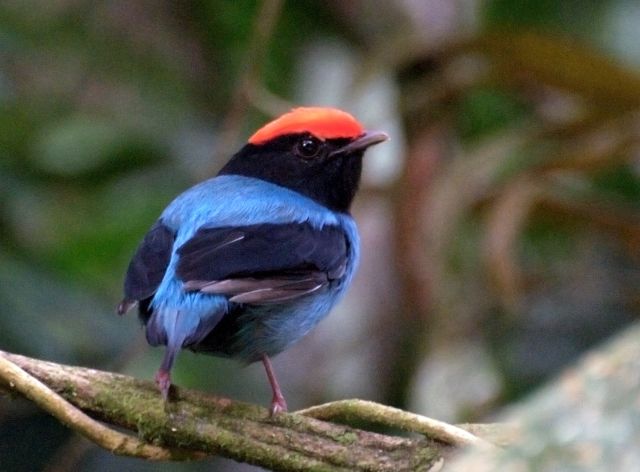
The blue manakin is a small bird that lives in the Atlantic forests of southeastern Brazil, the far northeast of Argentina, and eastern Paraguay. Males are a beautiful blue with a black head and red crown; they sing and dance to attract females, most males never succeeding. The olive-green females care for the offspring. They build their nests in a shrub or young tree, often above a stream.
Camouflage
A nest with eggs or young is vulnerable to predators. It must therefore be as unobtrusive as possible. And perhaps, Martins hypothesized, the sloppy tails on the blue manakin’s nests are a form of camouflage. A nest with such a tail is visible but not easily recognized as a nest. The shape is obscured.
He tested this by collecting abandoned nests and attaching them to branches in a new location. He clipped the tails of half of the nests. After placing two plasticine eggs in each nest, he set up a video camera that would trigger whenever an animal came in front of it. During twenty days, it recorded what happened; the incubation period is eighteen days.
Functional
Most nests remained untouched, but not all. And whether a tail was attached to the nest or not made a significant difference. One or both eggs were stolen from nests without tails ten times more often than from nests with tails: 20 percent compared to 2 percent. The culprits were other bird species, including a toucan and a motmot.
The tail on blue manakin nests appears to offer protection against predators that search for food by sight during the day. But the question remains to what extent this works when a nest is occupied, i.e., when there are real eggs in it or when the activity of the mother and her young could attract attention. In any case, the tail is not a sloppy feature, but a functional addition.
Willy van Strien
Photo: Blue manakin male. Dario Sanches (Wikimedia Commons, Creative Commons CC BY-SA 2.0)
Watch the courtship of blue manakin on YouTube
Source:
Martins, C.B., D.L. Bruno & M.R. Francisco, 2026. Why do birds construct nest tails? A test of disruptive camouflage in the blue manakin. Biology Letters 22: 20250453. Doi: 10.1098/rsbl.2025.0453