

Stolen chloroplasts influence the behaviour of the lettuce sea slug
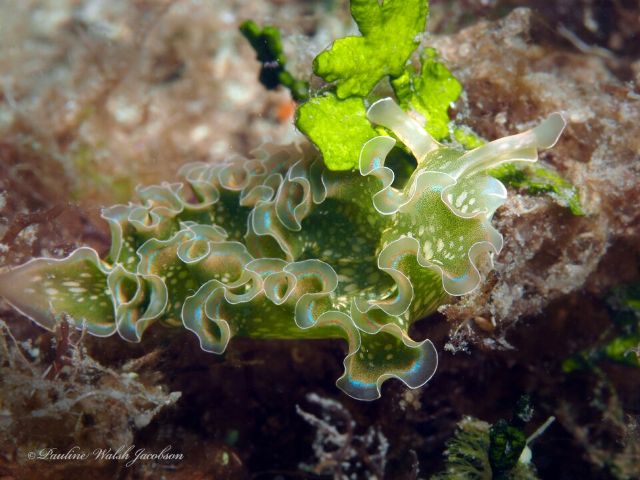
The chloroplasts carried by the lettuce sea slug Elysia crispata need light for photosynthesis. But light must not be too intense, and the green sea slug knows that light-sensitivity, Xochitl Vital and colleagues explain.
The lettuce sea slug, Elysia crispata, has chloroplasts in its body that have been ‘stolen’ from algae and give the animal a green appearance. Chloroplasts are small organelles of plant cells. The lettuce sea slug and some other Elysia species suck out the content of cells of filamentous algae and digest the contents. Except for the chloroplasts, which they keep intact and incorporate in special cells in the wall of their extensive intestinal tract.
In the green sea slugs, the chloroplasts continue what they did in the algae: with the help of sunlight, they capture carbon dioxide and convert it into carbohydrates and fats. This process, photosynthesis, produces oxygen. In a handful of Elysia species the chloroplasts, which are now called kleptoplasts, remain functional for months. These green sea slugs cannot survive without them. The lettuce sea slug is one of them. While it ensures that the stolen chloroplasts can capture sunlight, it avoids high light intensity, as Xochitl Vital and colleagues show, because excessive sunlight is harmful for the stolen chloroplasts.
Elysia species belong to the Sacoglossa or sap-sucking sea slugs. The lettuce sea slug lives in the western Atlantic Ocean and the Caribbean, on and near coral reefs, at depths of 5 to 10 meters. It is about 5 centimetres long and feeds on several algae species.
Solar energy
For a long time, the question was: why do green sea slugs like the lettuce sea slug retain the stolen chloroplasts for months? According to some researchers, once these animals have accumulated enough chloroplasts, they could henceforth live on solar energy just like plants. Others suspected that the chloroplasts are to be digested as food.
It turns out there is some truth to both. Green sea slugs cannot live solely on the carbohydrates and fats produced by kleptoplasts. They need to keep eating. But the products of photosynthesis help survive periods of food shortage. Also, they are used to boost fertility. So, the animals do use solar energy.
But in the event of a prolonged food shortage, the kleptoplasts can be digested, so they also form an emergency food supply.
Sun damage
Another question was: how do the lettuce sea slug and other green sea slugs keep their stolen chloroplasts active? Chloroplasts originate from photosynthesizing cyanobacteria. More than a billion years ago, a distant ancestor of plants absorbed such bacterium, which evolved into an integrated cell organelle within its ‘host’. Most of its genetic material (DNA), including genes for the synthesis and repair of its thousands of proteins, migrated to the host’s cell nucleus. Chloroplasts are therefore dependent on the plant’s genetic material for their maintenance. They kept only a few genes themselves.
Green sea slugs, however, only retain stolen algal chloroplasts, not the cell nuclei containing the maintenance genes. The lack of maintenance genes is critical because the kleptoplasts are exposed to a significant risk. Under intense light, aggressive oxygen compounds will form that damage the kleptoplasts’ proteins. Plants can scavenge these oxygen compounds or repair the damage thanks to the maintenance genes they acquired from resident cyanobacteria in the distant past. But how should green sea slugs maintain their kleptoplasts?
The researchers had previously shown that chloroplasts of some algae kept some of the original maintenance genes. This is effective in some cases, depending on Elysia and algae species. But maintenance abilities of the lettuce sea slug are poor. Nevertheless, its kleptoplasts remain active for up to three months.
Acclimatized
The lettuce sea slug, it turns out, protects its kleptoplasts by searching for low-light areas, even though this is not optimal for photosynthesis. Moreover, green sea slugs have flaps with a wavy edge on each side, parapodia, which they can fold over the kleptoplasts to block sunlight.
Now, the researchers show that the lettuce sea slug adapts its behaviour to the light tolerance of its kleptoplasts. Within plants, chloroplasts can acclimate to the environment: they can adapt to the amount of light available. In sea slugs, kleptoplasts cannot acclimate. They remain adapted to the light level they were exposed to in the algae they were stolen of. A lettuce sea slug with chloroplasts from algae grown in a habitat with high irradiance will choose a place with higher light intensity than a sea slug with chloroplasts from algae grown in a less bright location.
Surprising
In conclusion: the animals are actively looking for a place where the kleptoplasts can perform photosynthesis as much as possible without suffering significant sun damage.
It will help. Still, it is surprising that the lettuce sea slug and some other Elysia species recognize chloroplasts when they suck up the contents of algae, leave them intact and incorporate them into their cells. And that they manage to keep the stolen chloroplasts in good condition for months without having all necessary tools to do so. And that, apparently, it is worth the effort.
Willy van Strien
Photo: Elysia crispata. Pauline Walsh Jacobson (Wikimedia Commons, Creative Commons CC By 4.0)
Thanks to stolen chloroplasts, some Elysia species can regenerate a new body from a loose head
Sources:
Vital, X.G., S. Cruz, N. Simões, P. Cartaxana & M. Mascaró, 2026. The photoacclimation state of stolen chloroplasts affects the light preferences in the photosynthetic sea slug Elysia crispata. Journal of Experimental Biology 229: jeb251281. Doi:10.1242/jeb.251281
Burgués Palau, L., G. Senna & E.M.J. Laetz, 2024. Crawl away from the light! Assessing behavioral and physiological photoprotective mechanisms in tropical solar‑powered sea slugs exposed to natural light intensities. Marine Biology 171: 50. Doi: 10.1007/s00227-023-04350-w
Morelli, L., V. Havurinne, D. Madeira, P. Martins, P. Cartaxana & S. Cruz, 2024. Photoprotective mechanisms in Elysia species hosting Acetabularia chloroplasts shed light on host-donor compatibility in photosynthetic sea slugs. Physiologia Plantarum 176: e14273. Doi: 10.1111/ppl.14273
Cruz, S. & P. Cartaxana, 2022. Kleptoplasty: getting away with stolen chloroplasts. PLoS Biology 20: e3001857. Doi: 10.1371/journal.pbio.3001857
Cartaxana, P., E. Trampe, M. Kühl & S. Cruz, 2017. Kleptoplast photosynthesis is nutritionally relevant in the sea slug Elysia viridis. Scientific Reports 7: 7714. Doi: 10.1038/s41598-017-08002-0