
'/%3E%3C/svg%3E)
Hectocotylus of male inkfish does more than we thought
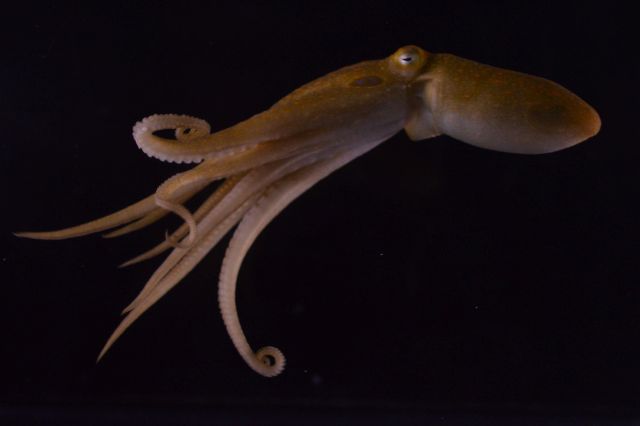
The reproductive arm or hectocotylus of a male octopus has a dual function, Pablo Villar and colleagues discovered. It is a precious arm with which males take no risks, Keijiro Haruki and colleagues show.
Just like in other cephalopod species, one of the arms of male octopuses has a special function: it transfers sperm to a female. It now appears that this arm knows how to find the right place to deliver the sperm on its own; it ‘tastes’ it, Pablo Villar and colleagues prove. This means that the reproductive arm has a second function; this was previously unknown.
Cephalopods have a ring of eight or ten tentacles around the beak, and, behind the beak, a bag of organs surrounded by the mantle. Testicles and ovaries are located deep within that mantle. In testicles, the sperm is wrapped up in packages. These will go the base of the reproductive arm and move through a groove to its tip. A male inserts the arm under the female’s mantle, and the arm then delivers the packages near the oviducts.
The scientific name of the reproductive arm is hectocotylus, a name that stems from an old misconception. In some cephalopods, the reproductive arm detaches and attaches itself to a female’s mantle. In the past, such an appendage could not be identified, and it was thought to be a parasitic worm. It was given the name Hectocotylus. But it was, in fact, a loose male arm.
Sex hormone
Octopus species have eight arms, and in males, the third arm on the right side is the hectocotylus. Villar conducted a series of experiments and observations on the California two-spot octopus, Octopus bimaculoides. It turns out that males and females can even mate when separated by an opaque wall containing a small hole. The male sticks his special arm through this hole. Then, the arm easily finds the female and subsequently the place where it must deposit the sperm packages. The researchers investigated how this is possible.
They discovered that the hectocotylus finds its way by responding to progesterone, a sex hormone that females produce in the ovaries. The arm detects the hormone using specific proteins (receptors) located on the suction cups and connected to the extended nervous system. The arm does not respond to other substances.
Other cephalopod species have their own variants of progesterone and corresponding receptors on the reproductive arm, so that an arm ‘knows’ whether it is dealing with a female of its own species.
No risk
The other arms of an octopus (seven arms in males, eight in females) also have suction cups with receptors, but these are sensitive to different substances and are used to find prey. They cannot take over the functions of the hectocotylus. And so, a male must be careful with that one special arm.
And he is, as Keijiro Haruki and colleagues show.
He studied the Japanese pygmy octopus, Octopus parvus, which lives in the intertidal zones of oceans. Toxic stinging sea urchins also live there. Another danger is posed by crabs that like to bite off an arm. After loss, an arm can regrow, but that takes a few months, while the octopus only lives for 1 to 2 years. Most pygmy octopuses, observations show, have lost an arm, but in males, it is rarely the reproductive arm. That is because they protect it by holding it close to their body.
In experiments, the researchers confronted the octopus with a fishing sinker. The octopuses touched it to explore it, but the males did not use their reproductive arm. In a subsequent experiment, the researchers hid prey in a cavity. Retrieving it is risky because a crab could also be hiding in such a cavity. In these experiments, the males only used their reproductive arm after they had assessed with other arms that it was safe.
Handicap
It is a minor handicap for males that they can only work with seven arms instead of eight. But protection of reproductive capacity comes first.
Willy van Strien
Photo: Octopus bimaculoides, male. © Anik Grearson
Sources:
Villar, P.S., H. Jiang, T. Shugaeva, E.L. Berdan, A. Kulkarni, M. Hiroi, G. Masucci, S. Reiter, E. Lindahl, R.J. Howard, R.E. Hibbs & N.W. Bellono, 2026. A sensory system for mating in octopus. Science 392: 96-101. Doi: 10.1126/science.aec9652
Haruki, K., Y. Yamate & T. Takegaki, 2026. Male octopus avoid using hectocotylized arm under situations with unpredictable risks. Ethology, online March 27. Doi: 10.1111/eth.70073
Weertman, W.L. & D. Scheel, 2024. Hold it close: male octopus hold their hectocotylus closer to their body. Marine Biology 171: 95. Doi: 10.1007/s00227-024-04398-2