

Burying beetles prepare, bury, and digest a small carcass for their young
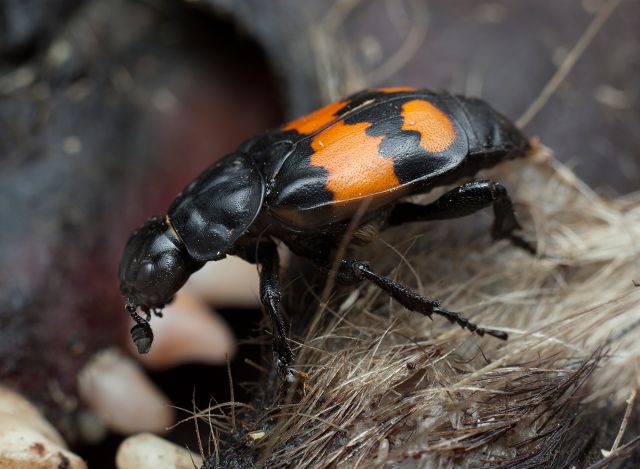
The effort burying beetles put into preparing a dead mouse for their offspring is enormous. Research by Eric Grubmüller, Erin Bolger, Madlen Prang and their colleagues shows that without this parental care, the beetle larvae hardly stand a chance to survive.
You may have spotted a black beetle with striking orange markings crawling along the forest floor: the burying beetle Nicrophorus vespilloides. The somewhat macabre name is fitting for a creature that thrives on the death of others. Found in Europe and elsewhere, Nicrophorus vespilloides is one of dozens of Nicrophorus species belonging to the carrion beetle family. Burying beetles distinguish themselves from other carrion beetles through their complex parental care; they adapt the carcass of a small mammal or bird to feed their carrion-feeding offspring. Recent publications show that this great effort is essential.
Decomposition
A carcass smells because of the metabolism of bacteria and fungi that decompose it. Burying beetles are drawn to this scent, particularly to the odour of fresh carcasses. Once they find one, they fiercely defend it against other burying beetles, using their mandibles as weapons. Usually, one male and one female remain and subsequently work together. At a large carcass, multiple pairs may join forces, and sometimes only a single beetle is left.
After having secured a carcass, the beetles bury it by excavating the soil from beneath it. While doing so, they strip away the fur or feathers. They shape the carcass into a ball as best they can, keeping the skin intact. All the while, they must protect and defend it against competitors, predators, and parasites. The burying beetles coat the meat ball with secretions from their mouths and anuses. The secretions contain substances that kill bacteria and fungi that are responsible for decomposition.
Preparing
Eric Grubmüller and his colleagues demonstrated that the work burying beetles do for their offspring before the larvae hatch has a significant impact. Specifically, they sought to determine how important it is for the larvae that the parents prepare a carcass. The researchers conducted experiments with Nicrophorus vespilloides and dead mice.
The larvae were presented with a buried carcass, inside which they had to develop without their parents. Few larvae succeeded. However, the experiments show that if a pair of burying beetles had been able to prepare the carcass beforehand, it made a difference to the chances of success: larvae on a prepared carcass had a higher survival rate and grew heavier than those on an unmodified one.
The parent beetles’ activities alter the community of microorganisms (bacteria and fungi) on the small carcass. As a result, it emits different odours than an unprepared carcass and attracts fewer other carrion-feeding species. And although microbial communities vary by soil type, roughly the same species of bacteria and fungi are found on prepared carcasses regardless of location. Apparently, the beetles introduce microorganisms via their secretions, remove unfavourable species from the soil that would otherwise colonize the meat ball and preserve species that could help digest the meat.
Burying
So, it is important for burying beetles to prepare a carcass for their offspring. Erin Bolger demonstrated that burying the carcass is also essential – after all, the beetles did get their name for good reason. A breeding attempt by the burying beetle Nicrophorus orbicollis from North America failed completely when Bolger provided a pair with a carcass (a mouse, as in the other experiments) but prevented the two from burying it. Even though the beetles prepared the carcass making it less attractive, there were still so many blowflies, flesh flies, other carrion beetles, and larger scavengers that pounced on the carcass if it remained unburied, that the burying beetles could not defend it.
Because decomposition odours do not spread effectively from the soil, a small carcass underground is better hidden from other scavengers. Burial offers more advantages: a stable microclimate underground with less extreme temperature fluctuations. It is cooler, which slows decomposition, and the carcass does not dry out in a short time.
Feeding
Once the burying beetles have their ball ready, the female lays her eggs in the soil nearby. This marks the start of a new phase. By the time the larvae hatch, the parents incise a hole in the ball and dug a small tunnel, where the larvae gather. Inside this cavity, which gradually expands, the larvae can self-feed, but usually both parents regurgitate pre-digested meat in liquid form for them. Experiments with Nicrophorus orbicollis conducted by Madlen Prang demonstrate how important this feeding is. If the parents do not feed the larvae, they grow poorly and have little chance of survival; but if the parents do feed them, they develop well, especially if the meat ball has been well prepared.
There may be so many larvae that there is not enough food. In that case, the parents consume some of them. By the time the remaining larvae are fully grown, the whole meat ball is gone.
Next generation
In conclusion: burying and feeding are the most important elements of parental care in burying beetles. Once fully grown, the larvae disperse, pupate, and emerge from the soil as adult beetles. And they will search for fresh new carcasses.
Willy van Strien
Photo: Nicrophorus vespilloides on carcass. Stanislav Snäll (Wikimedia Commons, Creative Commons CC-BY 3.0)
See the hard work of Nicrophorus vespilloides on YouYube
Sources:
Grubmüller, E., D.V. Meier, M. Kreil, L. Schmit, E. Scharl, M. Takata, A. Weig & S. Steiger, 2026. Parental niche construction buffers microbial and competitive challenges and drives offspring dependence in burying beetles. PNAS 123: e2617749123. Doi: 10.1073/pnas.2617749123
Bolger, E. & P.R. Martin, 2026. Why do burying beetles bury? Competition and the fitness benefits of parental care. Behavioral Ecology arag100. Doi: 10.1093/beheco/arag100
Prang, M.A., D. Lauterbach, P. Schober & S. Steiger, 2025. From constructing nests to nutritional provisioning: the impact of direct and indirect parental care in the burying beetle, Nicrophorus orbicollis. Behavioral Ecology and Sociobiology 79: 103. Doi: 10.1007/s00265-025-03635-y
Potticary, A.L., M.C. Belk, J.C. Creighton, M. Ito, R. Kilner, J. Komdeur, N.J. Royle, D.R. Rubenstein, M. Schrader, S-F. Shen, D.S. Sikes, P.T. Smiseth, R. Smith, S. Steiger, S.T. Trumbo & A.J. Moore, 2024. Revisiting the ecology and evolution of burying beetle behavior (Staphylinidae: Silphinae). Ecology and Evolution 14: e70175. Doi: 10.1002/ece3.70175