
'/%3E%3C/svg%3E)
Larvae of the black oil beetle smell like flowers
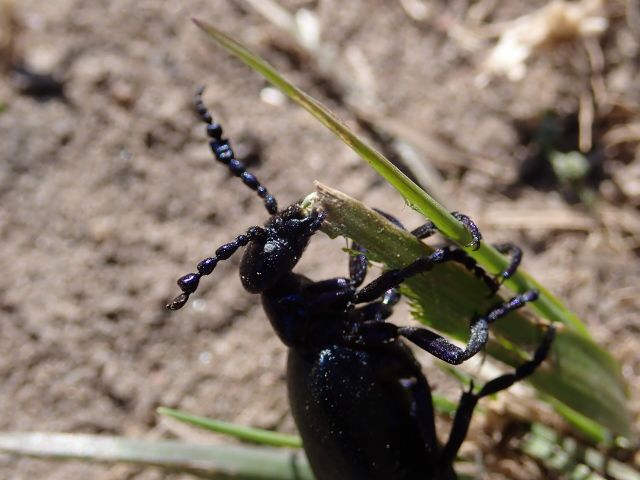
Larvae of the black oil beetle mimic floral scents to lure bees, Ryan Alam and colleagues show. They then have themselves transported to the bees’ nests to live there as parasites.
Without any care, female oil beetles leave their eggs behind. Once the larvae hatch, they have to find food on their own. And they succeed – by exploiting the parental care that solitary (non-colony living) bee species provide to their offspring. A female bee adds a food supply of nectar and pollen to her eggs for the larvae. The oil beetle larvae consume both the bee’s eggs and the food supply.
Before they can eat, however, they must first find and infiltrate a bee’s nest. Larvae of the black oil beetle, Meloe proscarabaeus, have a foolproof method for this: they let themselves picked up by a female bee and are transported to the nest. In this way, they use bees in two ways: first as a taxi and then as a food provider. These oil beetle larvae manage to deceive their victims through their behaviour and colour. Now, Ryan Alam and colleagues show that, in addition, they smell like flowers.
The black oil beetle is a European species. It owes its name to the oily substance that adult beetles secrete when threatened; this is to deter the attacker. The larvae only parasitize on bees that make their nests in the ground.
Fatal attraction
Female black oil beetles lay clutches of thousands of eggs in the ground in early spring. The larvae that hatch operate as a unit. Together, they crawl out of the ground, climb up a blade of grass, and settle in a clump. As the larvae are orange in colour, such a clump stands out. A bee might mistake it for a flower.
But the disguise goes further, research by Alam reveals. His chemical analyses show that the black oil beetle larvae do something remarkable: they produce a bouquet of floral scents. They synthesize and release substances that are identical to floral fragrances.
Female bees collecting nectar and pollen may make an understandable but fatal mistake by relying on the scent and colour of a cluster of oil beetle larvae and inspecting it. Before a bee realizes the mistake, several beetle larvae have already attached to her with their claws. They then hitch a ride to her nest, where they dismount. They have made it: they are assured of food. When their development is complete, they pupate in the ground. In the spring, a new generation of adult oil beetles emerges.
Strategy
A weakness is that, by imitating flowers (mimicry), the larvae attract a broad range of pollinators, including species that are unsuitable as hosts, such as colonial bees or solitary bees that nest in cavities in for instance wood. Larvae transported by such bees are lost. However, these beetles can afford that loss thanks to their strategy of laying thousands of eggs at once. Every bee that approaches a cluster of larvae takes several of them along as passengers. At least a few larvae will end up in the right place.
Transfer
Larvae of oil beetle Meloe franciscanus, a species that lives in the southwestern United States, also parasitize solitary bees with nests in the ground. To travel to the nests, these larvae take a different approach. They also group together as a cluster on a plant stem, but they are dark coloured, like bees. And they produce the sex pheromones of females of the bee genus Habropoda, attracting specifically Habropoda-males looking to mate. Larvae climb onto such a male, and when he later mates with a female, they crawl to her and travel along to her nest.
These larvae attract only suitable host bee species, that make nests in which they can actually develop. That is more effective. On the other hand, they have to make a transfer, which adds an additional step that might fail.
Willy van Strien
Photo: black oil beetle, Meloe proscarabaeus. Salicyna (Wikimedia Commons, Creative Commons CC BY-SA 4.0)
Watch the behaviour of black oil beetle on YouTube
Sources:
Alam, R.M., D. Kessler, H. Vogel, K. Luck, A. David, M. Kunert, G. Brehm, M. Kaltenpoth, S.E. O’Connor & T.G. Köllner, 2026. The floral illusion: a parasitic beetle mimics the scent of flowers to attract bees. PNAS 123: e2602521123. Doi: 10.1073/pnas.2602521123
Saul-Gershenz, L.S. & J.G. Millar, 2006. Phoretic nest parasites use sexual deception to obtain transport to their host’s nest. PNAS 103: 14039-14044. Doi: 10.1073_pnas.0603901103