
'/%3E%3C/svg%3E)
Injuries of stony coral heal faster in the presence of fish
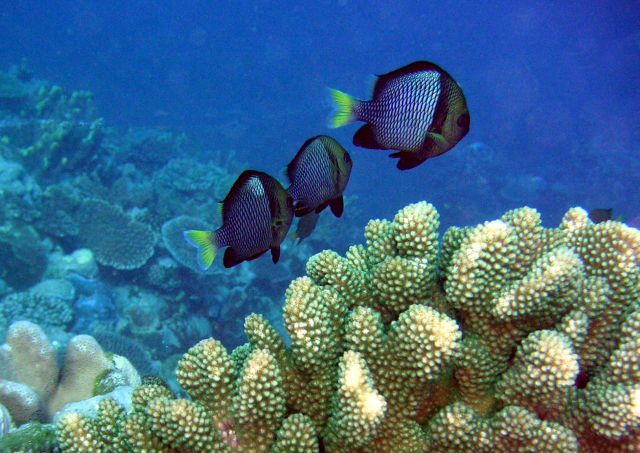
A damaged Pocillopora stony coral can repair the injury and regenerate the tissue. This happens most quickly if damselfish are nearby, Hayden Vega and colleagues write.
Stony corals of the genus Pocillopora are hard but also brittle, and therefore occasionally need to be repaired. Experiments by Hayden Vega and colleagues show that the presence of the damselfish Dascyllus flavicaudus accelerates the healing process.
Stony corals, that build up coral reefs, are small communities. A coral consists of a colony of polyps, animals related to jellyfish; the polyps are surrounded by a calcareous skeleton and catch small prey with their tentacles. They harbour certain single-celled algae that give the coral its colour. Like plants, the algae capture carbondioxide using sunlight, convert it into oxygen and sugars (photosynthesis), and supply it to their host. In return, they have a suitable, sunlit living environment within the polyps and receive nutrients such as nitrogen.
Damage
But the coral community is larger. Different animal species, including fish, shrimp and sea slugs, dwell on and near stony corals. Their presence and activity influence the growth, health, and integrity of the corals. Animals, for example, can nibble on it or clean a piece to lay eggs on.
Vega wondered whether species living near stony coral might also influence recovery when a piece of coral has become damaged by animal activity, storms, boats, or divers. Coral can often repair such injury. It has to, because pathogens can enter through a hole or turf algae can grow on it. But repair takes energy, so support is welcome.
He collected coral fragments of Pocillopora species for his research; these occur in the Pacific and Indian Oceans. He distributed 72 equal-sized pieces of coral across six aquariums and with an airbrush inflicted wounds of a few square centimetres to about fifty pieces. Then, he added six damselfish to half of the tanks. The species used was Dascyllus flavicaudus, one of the most common fish species associated with stony coral. He monitored the corals for three weeks.
Repair
The fishes turned out to be beneficial company. In tanks with fish, damaged corals recovered faster. There was no growth of unwanted algae in those tanks, and the damaged corals were able to maintain their photosynthesis levels.
The presence of fish likely increased the rate of recovery by enriching the water with nitrogen (a nutrient for the algae) through their excretory products and because their movements constantly refresh the water around the coral. This is particularly beneficial at night, when photosynthesis ceases and the coral requires oxygen. This demonstrates once again the importance of a well-developed, species-rich community.
The acute injuries in these experiments cannot be compared to the chronic damage corals sustain from ocean warming. In that case, they shed their algae and bleach. No fish can help cure that.
Willy van Strien
Photo: yellowtail dascyllus, Dascyllus flavicaudus. Natomic (Wikimedia Commons, Creative Commons CC BY 4.0)
Source:
Vega, H., C.W. Osenberg, A.W. Seifert, N. Munk & A.C. Stier, 2026. Coral-associated fishes accelerate coral wound healing and photosynthetic recovery. Biology Letters 22: 20260177. Doi: 10.1098/rsbl.2026.0177