

Red harvester ant is getting cleansed
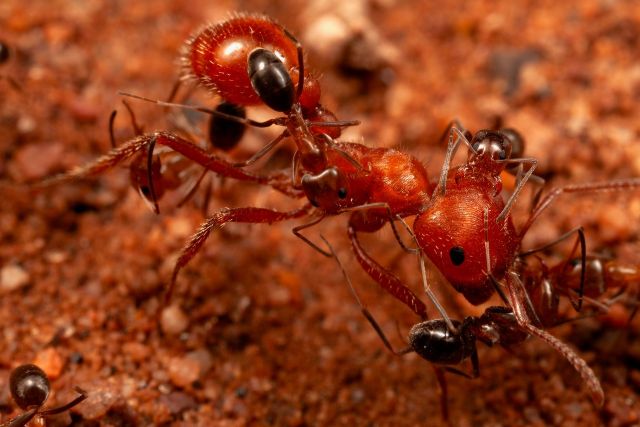
Mark Moffett discovered that a red harvester worker allows smaller ants to lick and nip her. Likely, she is getting a cleaning.
You usually see worker ants busily at work. But a worker of the red harvester ant, Pogonomyrmex barbatus, sometimes stands frozen in place, high on her legs, body raised, and jaws agape. And then something strange happens, Mark Moffett observed: one or a few ants of another, much smaller species (a Dorymyrmex species) climb onto her and begin licking, nipping, and pulling, even between her large and dangerous jaws. What is going on here?
Red harvester ants, also known as Pogos, live in arid regions in the southwestern United States. They build their nests in the ground. Worker ants go out to collect seeds; they grind the seeds with their jaws and store them in underground granaries as a food supply. The seeds also provide some water.
Cleaning act
But foragers sometimes pause for a moment. They often position themselves near or even right on a nest entrance of Dorymyrmex, which also nests in the ground, and they seem to wait for Dorymyrmex workers, or Dorys, to appear. That does not take long. A Pogo then allows itself to be inspected, licked, and nipped. When she has had enough, after seconds or minutes, she shakes the Dorys off vigorously and gets back to work.
The Dorys reminded Moffett of cleaner fish: small fish that have a ‘cleaning station’ on a coral reef. Larger fish stop by for a cleaning, and cleaner fish remove dead skin and blood-sucking parasites from them. The cleaners gain a meal, and the customers get rid of parasites.
Could Dorys be cleaner ants, and Pogos their customers? Do both parties benefit from their interactions, just like in cleaner fish?
It strongly appears so. The two ant species have their nests close to each other. The treatment that the Pogos happily endure and even elicit suggests that it is indeed a matter of cleaning. How do Pogos, which also groom each other, benefit from this? It is possible, Moffett supposes, that Dorys, by reaching smaller corners, can remove pathogens that are hard to reach. And it is plausible, though not yet proven, that the Dorys ingest some food while cleaning.
Tensions
There are many species of cleaner fish, recognizable by their tweezers-like snout and striped pattern. They have developed complex behaviours that reveal conflicts of interest that can exist between service provider and client. The bluestreak cleaner wrasse, Labroides dimidiatus, for example, may secretly cheat its clients and nibble on their protecting mucus layer. But despite such tensions, the cooperation is stable.
It makes one curious about the Dorys. Are they really cleaner ants? Could there be more cleaner ant species? And what exactly are their relationships with customers like?
Willy van Strien
Photo: Five ‘cleaner ants’ inspect the body of a red harvester ant (Pogonomyrmex barbatus). ©Mark Moffett, Minden Pictures
See older posts about complex interactions between bluestreak cleaner wrasse and its clients: hypocritical behaviour, cleaner wrasse cheats client secretly.
Source:
Moffett, M.W., 2026. The first cleaner ant? A novel partnership in the Arizona Desert. Ecology and Evolution 16: e73308. Doi: 10.1002/ece3.73308