

Orchid bees rob scent collection from dead conspecific
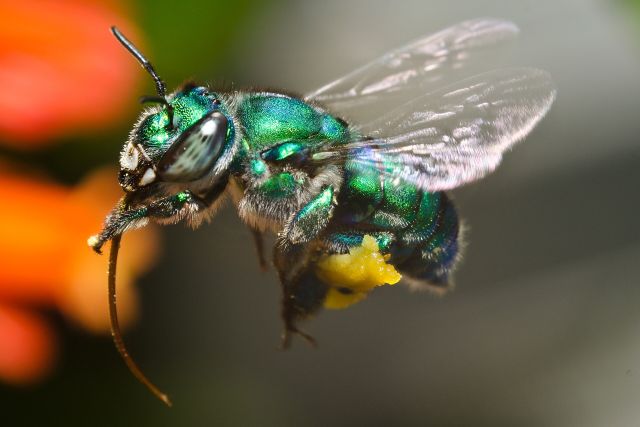
Male orchid bees carry a valuable, self-made perfume. Given the chance, they readily steal the scent collection of a dead conspecific male, according to Rafael del Castillo and his colleagues.
Male orchid bees try to seduce females with an alluring scent. They collect fragrances and store them, encased in lipids, in special pouches on their hind legs. Each species of orchid bee – there are around two hundred species, all found in tropical America – has its own distinctive bouquet of scents. These fragrances come from orchids, which the males pollinate while picking up the scent; hence the name ‘orchid bees’. The bees add a variety of other scents to the blend, such as sap from tree wounds.
And sometimes they pick up scents from the legs of a dead conspecific, Rafael del Castillo and his colleagues observed.
Bit of luck
Males release some of their perfume during courtship. It enables females to recognize males of their own species, as Marissa Sandoval and colleagues found for the closely related orchid bee species Euglossa dilemma and Euglossa viridissima. The intensity and complexity of the scent blend also indicate whether a male is in good condition and capable of gathering the right components, according to theory. This is because many scent components are scarce, making the task of building up a good supply a demanding one. Especially young males invest a great deal of time and energy.
Therefore, it is a stroke of luck if they can take the scent collection of a deceased member of their own species.
It had been observed previously that orchid bees sometimes steal scents from the hind leg of a dead member of the same species, or from a detached leg. Del Castillo confirms this with observations in Mexico, in both a dry landscape and a botanical garden, on Euglossa dilemma and Euglossa viridissima (that are indistinguishable to the naked eye), and Eulaema polychroma.
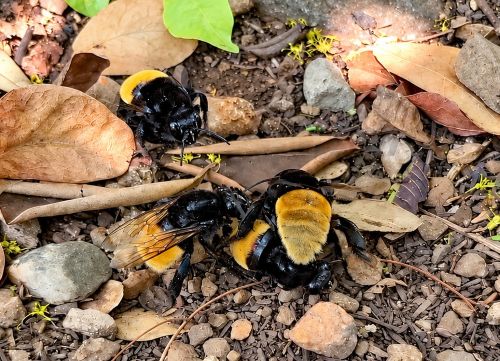
The researchers observed males lingering near a dead male of their species or a detached hind leg, displaying behaviour indicative of scent collection, which we described in an earlier post. Often, multiple males were present simultaneously, and one of them would attempt to defend the find against the others by pushing them with its head and legs. But although competing, the bees that Del Castillo observed were not very aggressive towards one another.
Biting off a leg
It is somewhat macabre behaviour, yet understandable: it saves a great deal of effort to simply appropriate a ready-made perfume blend, including scarce components, from a dead conspecific and show it off. After all, the deceased individual no longer uses it, so it suffers no harm.
However, this may be different in another species that is found in Brazil, Eulaema nigrita. Males of this species may sometimes bite off a hind leg of another male to steal the perfume, as Fernando da Silva Carvalho Filho reported in 2010. Now that would be truly macabre.
Willy van Strien
Photos:
Large: Euglossa viridissima male with filled perfume pouches. Eframgoldberg (Wikimedia Commons, Creative Commons CC BY-SA 3.0)
Small: Eulaema polychroma males around dead conspecific. ©David Alejandro Velasco-Filio
Sources:
Castillo, R.F. del, P.A. Gonzalez‑Vanegas, R. Cruz‑Romero, D.A. Velasco‑Filio, J.S. Fernandez‑Silva & M. Zarazúa, 2026. Scent‑Robbing by Male Orchid Bees (Apidae: Euglossini) in the Central Valleys of Oaxaca, Mexico. Journal of Insect Behavior 39: 31. Doi: 10.1007/s10905-026-09924-2
Sandoval, M.C., J. Dohrs, T. Chouvenc, T. Eltz & S.R. Ramíreza, 2026. Mate recognition in orchid bees is mediated by acquired chemical signals. Behavioral Ecology: arag 124. Doi: 10.1093/beheco/arag124
Carvalho Filho, F. da S., 2010. Scent-robbing and fighting among male orchid bees, Eulaema (Apeulaema) nigrita Lepeletier, 1841 (Hymenoptera: Apidae: Euglossini). Biota Neotropica 10: 405-408. Doi: 10.1590/S1676-06032010000200038
Leave a Reply